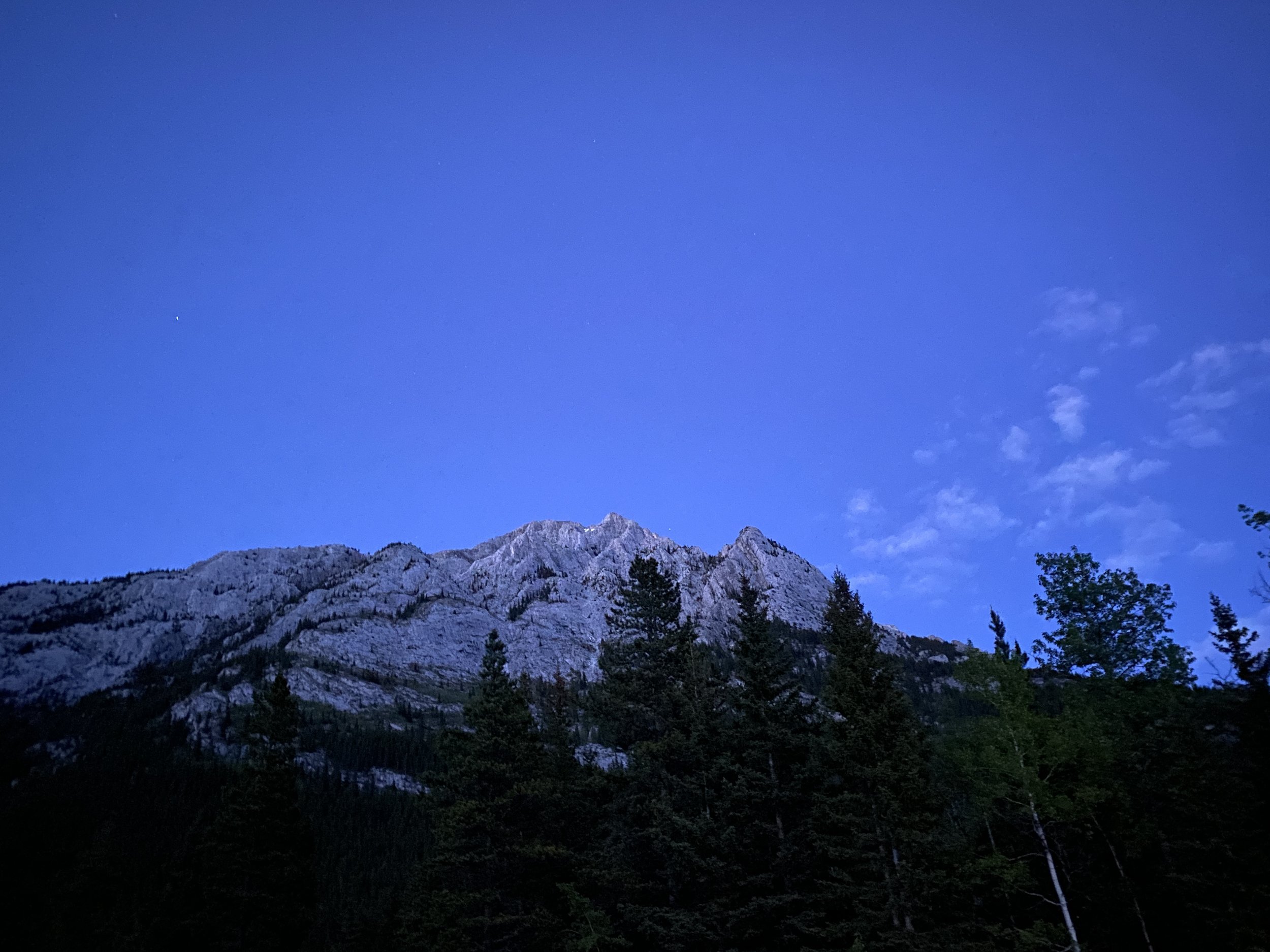
Looking up past the tops of trees and a rocky mountain at a big, blue sky.
One of the deepest fears I hear writers talk about is the fear of being boring.
They don’t want to write the same old story about nature, or immigration, or their difficult childhood, or marriage, or menopause. They want their work to feel new, like something that has never happened before, something that is theirs and theirs alone.
Of course they do. I do too. The idea that our work can be constantly unique and unprecedented is delicious.
But in the grip of all that pressure, what are we losing?
In my early days as a writing coach, I’d give that fear a lot of space. I’d work with my clients to map out what’s past the parts that feel tired, to find a voice or perspective that was fresh and bold. Then, newly motivated, they’d go to write that thing.
… And it would bomb. Every time. The writer would stall and not come back. They’d left their true story behind, and the force of their creativity had gone with it.
Last week I was reading Jordon Abel’s stunning memoir, NISHGA.
Jordan is a Nisga'a writer, whose paternal grandparents were brought up in a residential school. The book is written in fragments, with art, court transcripts, conversations, and notes, all slowly untangling the confusion and dislocation of inter-generational trauma.
In one part, he describes a job interview, where he was presenting his writing and parts of his story to an academic panel. One professor speaks up at the end and says, “What’s new about this?” Jordan writes:
If he asked me that now, I would just say: “Nothing. This is an old, sad, painful story that hurts just as much yesterday as it does today. There’s nothing new about it but it’s still not going anywhere.”
It’s still not going anywhere. There it is.
We carry the stories we carry. We do our best to honour and care for them. Writing lets us give them life — form and language and relationship.
When we also demand that they are new and fresh and bold, they often stretch and break. We stall and can stay stalled. We block them.
And is that a fair thing to ask of a story?
I have a pet theory that we all have 4-6 things we’re trying to say at any point in our lives.
We repeat them over and over, as answers to “How was your day,” as emails, as fiction, as poems, as texts, as academic pursuits, as social media updates.
Maybe yours is “My mom died” or “Coming out was really hard” or “You can’t trust love” or “The only thing you can trust is love” or “The future is bleak” or “I miss my brother.”
These are rarely complicated. They are always personal.
More and more, I think the whole point of writing is to be with those stories, to tell them, over and over, until we’re done, and ready for new stories to take their place.
This is what I’m most interested in now — everyone writing exactly what they can’t stop writing.
I’m interested in seeing the writers I love (yes of course that’s you) stand in the centre of their material with self-trust. I’m interested in the energy that is released when we write what we most need to write.
As readers, we want that. We can feel when an author is working from their authentic and urgent voice. It feels like connection, like holding hands.
Ran Ortner, a painter known for huge tableaus of the ocean, writes:
Art is not a skill contest, nor an innovation contest. Art is an honesty contest. If we can be precisely who we are, in the most intimate and candid and courageous way, we will start to connect to the universal. Our job as artists is to become powerfully personal in our work.
That picture up there reminds me of something important.
I took it on a camping trip last month. We flew out to Calgary because we needed to see something huge and ancient.
Writing this newsletter, I kept thinking about those mountains. How comforting it is to be with old things, things that knew the world before us, and will know it long after us too.
Maybe we can see our stories like that too. Maybe we don’t need to invent them as much as we need to appreciate them, and be part of their enormous and mysterious lives.
So, here’s to all of our old stories. May we sit at their slopes together in awe.
In it with you,

P.S. Such great teachers in this newsletter. Here’s a link to check out Jordan Abel’s book (one of many), and here’s the interview with Ran Ortner that the quote is pulled from.