Is a piece of writing ever truly finished? (A note from Britt.)
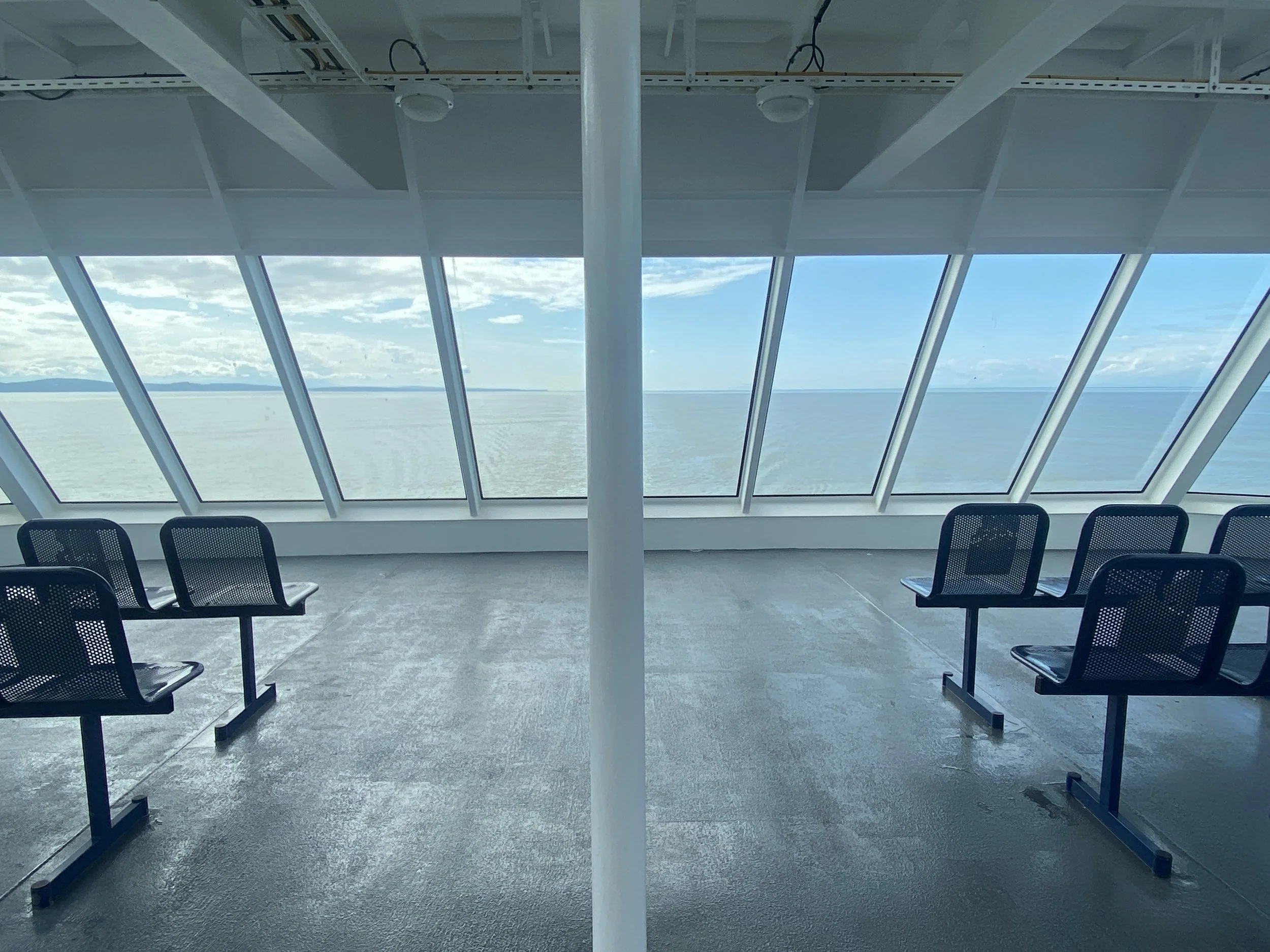
The view off the back of a ferry boat, which looks oddly futuristic, with simple black chairs facing a sloping bank of windows, and ocean beyond.
As writers, we tend to think a lot about finishing.
There’s a dream of laying down that final perfect sentence – the last period placed right where it needs to be, all the ideas and storylines tucked in at the edges.
I’ve felt the longing for neat and tidy completion. But more often than not, I finish a piece of writing and can’t tell if it’s actually “done.”
In his book, The Fault in Our Stars, John Green writes: “You die in the middle of your life, in the middle of a sentence.”
I can’t stop thinking about that. I’m going to leave my life with things unfinished. There will be unfolded laundry, couch cushions that need straightening, unspoken truths, relationships un-mended. Dirty dishes languishing in the sink.
And what does this mean when it comes to writing projects? Is there a way to finish what we need to finish? Is there such a thing as “complete”?
In my recent Progress workshop, we had a fascinating conversation about how when it comes to big projects, many writers get to the end of the story and realize that their writing voice has evolved since they started. The beginning doesn’t match the end anymore. They understand the characters differently, or their tone has changed, or the story at the heart of the story has evolved. They are not the same people they were when they began.
Questions exploded in our little Zoom room.
Should they go back to the start and revise everything to fit this new voice?
Would that begin a never-ending loop of evolution and revision?
Is it OK to grow while we write, does that need to be changed?
Even when a piece of writing is out in the world, it still may not feel done.
Years ago, I had the honour of studying with Wayson Choy, who told me that he couldn’t bring himself to re-read some of his novels, because he’d be overcome with the desire to revise them.
Of course, I read his books and they feel complete, polished, everything in place, but maybe we need to surrender that certainty when we’re with our own work.
Here’s a little clue. The origin of the word finish, traces back to the Latin word finire, meaning “to limit or set bounds.”
What if that’s it?
What if creating something simply means travelling with it for a period of time, and then stepping back?
We say what we can, as best we can. Then we reach the limit of what we can know for now, and we stop.
Can it be that simple?
Can we let it?
Do we have any choice?
If you’re looking to ask these questions in good company, or find some support in your own creative travelling, read on…
We have one small group workshop starting this fall with space left.
City Sanctuary: The BIPOC Edition is a one-day, in-person “retreat” on December 6th with Asifa and Kim at the historic (and accessible) St. Matthew’s Clubhouse in Toronto.
Winter workshops will be up on our website on October 23rd, and financial aid applications open that day.
We have a fun schedule planned this winter, including a brand new workshop for folks who want structure and support to submit work out in the world, and new programming for our LGBTQIA+ community.
Anyone can apply for financial aid — if the price is a barrier, step right up.
Join us every weekday morning at 9am.
Morning Coffee Sessions don’t get a lot of space in the newsletter because they are a constant part of our routines, but we want to remind you today!
You can join us every weekday at 9am Eastern Time for a prompt, a poem, and 20 minutes of writing time. Sliding scale. Simple and good. We’d love to see you.
And a poem, of course.
Here’s a poem for you by Naomi Shihab Nye. I think you’ll know why I chose it.
Before I go, I want to share one more thing with you that’s squeezing my heart.
The Loose Ends project is a worldwide non-profit initiative where volunteer crafters are matched with unfinished textile and handwork projects left behind by people who have died.
Maybe someone can create a version of this for writers, where periods get placed at the end of our unfinished sentences. Wouldn’t that be such a gift?
Yours in the mystery,