Maybe this is how we remember ourselves.
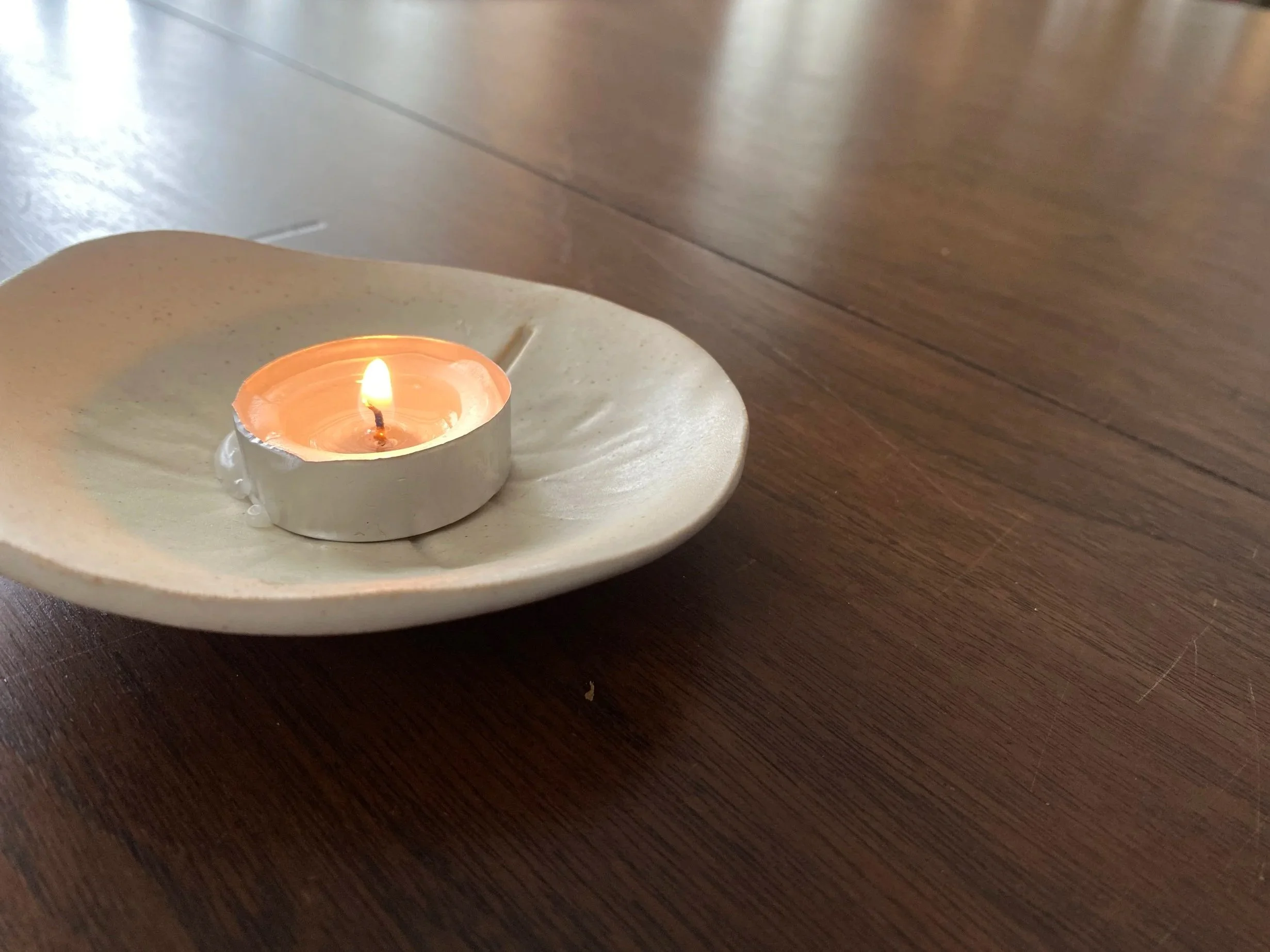
A tealight in a cream-coloured dish on a wooden tabletop.
Lately I’ve been spending as much time as I can in a nursing home in Ottawa.
That’s where Linda lives. I’ve written about Linda here before — sometimes I call her my “godmother,” because it’s the best word I have for her, and there’s a whole other essay to write about the inadequacy of language to capture all the ways there are to love someone.
When I say she has dementia, everyone asks the same question — “Does she know who you are?” I’m not sure how to answer this. She lights up when she sees me. She points to me urgently, and tells the nurses, “This woman is extraordinary.” Once in a while, out of the fog, she says my name, and I catch the surprise in both our eyes.
The last time I was there, I brought a book — Anam Cara by John O'Donohue. It’s a lyric reflection on Celtic wisdom and friendship. I asked Linda if she wanted me to read it to her, and she looked away. She can be hard to read these days.
I settled in anyway, leaning forward on my knees. John can get a little intense — lots of description of the fingers of dawn grasping the night sky. Then Linda leaned forward too. “She’s really taking this in,” I thought, adding a little more emphasis to each word.
When I paused to turn the page though, she looked up at me, baffled, and said, “Why are you saying all these words?”
I laughed, took the hint, and put the book away.
It was a good question though. Why all the words?
Anyone who loves to write is surrounded by them. Sometimes they feel like a swamp and sometimes like a swimming pool. Imagine if you could stretch out every word you’ve ever written out in one long line — uncurled your s’s, uncrossed your t’s. How far would they go? Around the world? Twice?
We speak, we write, we scribble, we reach for each other, we try. We are building a body of work, even if we would never call it that. There’s a number of times you’ve said “I love you,” a number of times you’ve said “fuck.” And that number will come to an end. We all only have so many.
Linda loves words. She has a PhD in English Literature and wrote all her life. We used to spend hours reading each other poems, revelling in tiny turns of phrase. She’d say “Oh that line is so you, can you hear it?” It felt ecstatic, being known in this way.
When we walk the halls of the home, Linda wants to tell everyone that they are wonderful.
This is how she uses words now. She compliments outfits. She pauses if someone looks sad or lonely to ask if they need anything. It reminds me of E.B. White, who said, “All I ever hope to say is that I love the world.”
Maybe words are always standing in for something vast and unknowable. Maybe we write because we are trying to grasp something right on the edge of what we can say. Maybe this is why we keep trying, because the things that matter most to us will never fully land in language, so we keep drawing ribbons of ink around the world, trying.
Maybe this is how we remember ourselves, even on our foggiest days.
Let’s let John O’Donohue take this one out.
His short poem “Fluent” goes:
I would love to live
Like a river flows,
Carried by the surprise
Of its own unfolding.
Yes, please. I’ll meet you there.
